


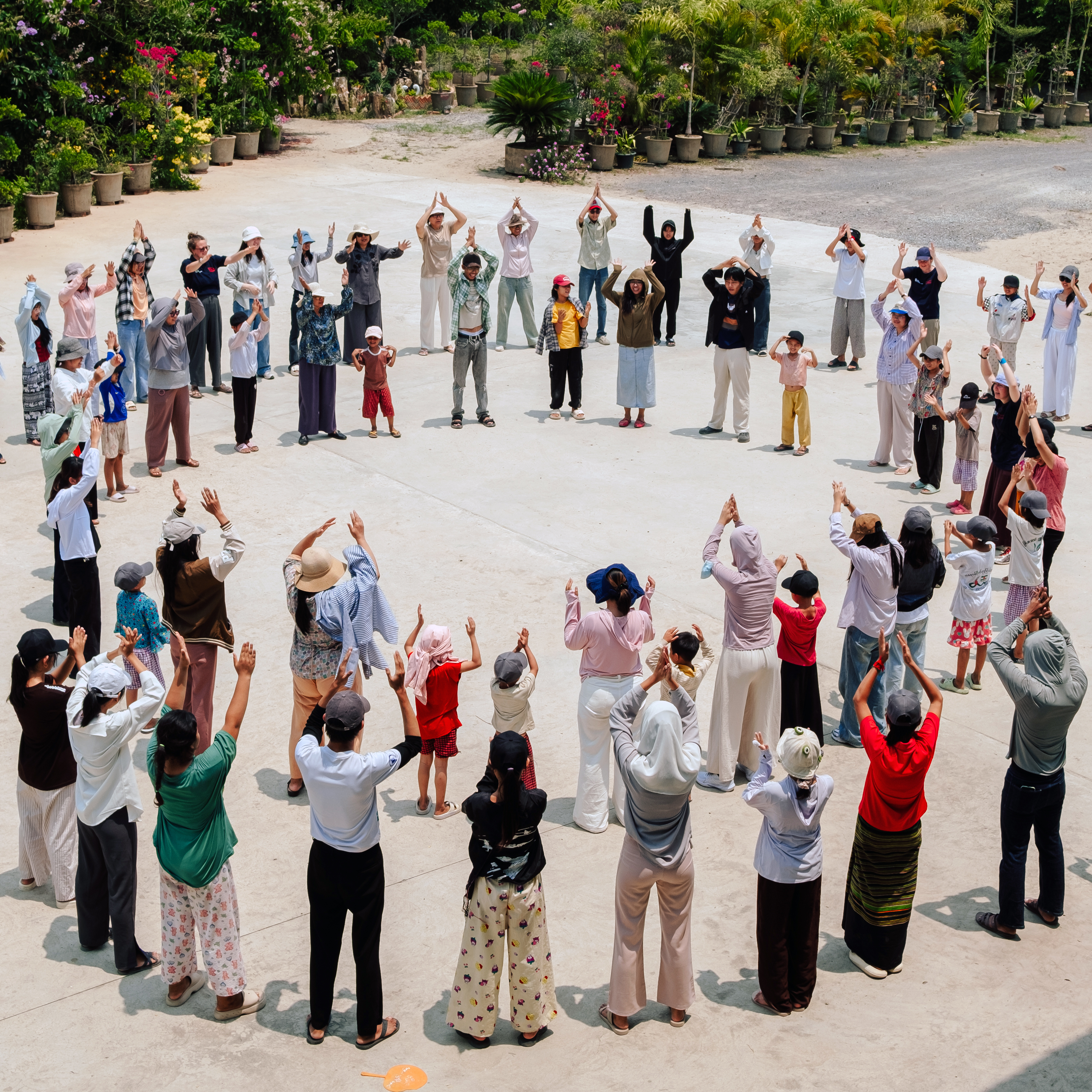
Our team first arrived in Mandalay to run a training session for both teaching staff and children. The former royal capital is located in the centre of the country and is not far from the epicentre of the earthquake. Even more than a year later, the damage is still visible in many places.
We had already worked with the local organisation ADORE Mental Health and Wellbeing last October as part of an introductory training session. In their feedback at the time, the 15 participants had expressed a desire for a deeper exploration of the topics, which we took into account in our current workshops. This time, we built on the theoretical content from the previous training on emergency pedagogy and psychotraumatology, as well as on practical sessions in eurythmy, art therapy and experiential education.
With 50 professionals and volunteers, significantly more people took part than in the last training session. In addition, we spent two mornings working with 30 children from a monastic school who had experienced last year’s earthquake. Most of the children also come from war-torn areas. Their parents sent them to this school in Mandalay – in the hope of safety and a bright future.
In conversations with the adult participants, it became clear that they had gained important insights for their professional and personal lives from our joint work. One participant summed it up: “It was very enlightening for me to understand how empathetic understanding and building good relationships can create a safe space.” Another adds: “Movement and rhythm are very useful tools for helping children, but also ourselves.”
For many years, we have been working closely with a group of Waldorf kindergarten teachers from various regions in Myanmar who have been caring for young children in different projects for up to twelve years. Since the earthquake, their need to integrate trauma-informed approaches into their daily work has increased significantly. Following our initial training days, we were able to meet 30 of them south-east of Mandalay at Inle Lake to work intensively with them for four days.
Right from the first day, it became clear just how special the workshops were for some of the participants. Some of them had travelled for up to three days to get there, mainly from the conflict-ridden areas in the north of the country. These days without air strikes were a great respite from their daily lives. Alongside the topics of ‘emergency pedagogy and ‘trauma-sensitive work with young children’, the theme of ‘self-care’ was another focus point of the training. At the end, one participant said: “Over these four days, all the heaviness has left my body. I can see the light again and am taking away a lot of new insights for myself personally and for my work.”
Another mission to Myanmar is planned for October 2026, during which we intend to build on the training content and further consolidate what we have learnt.
Lina Bäuerle