


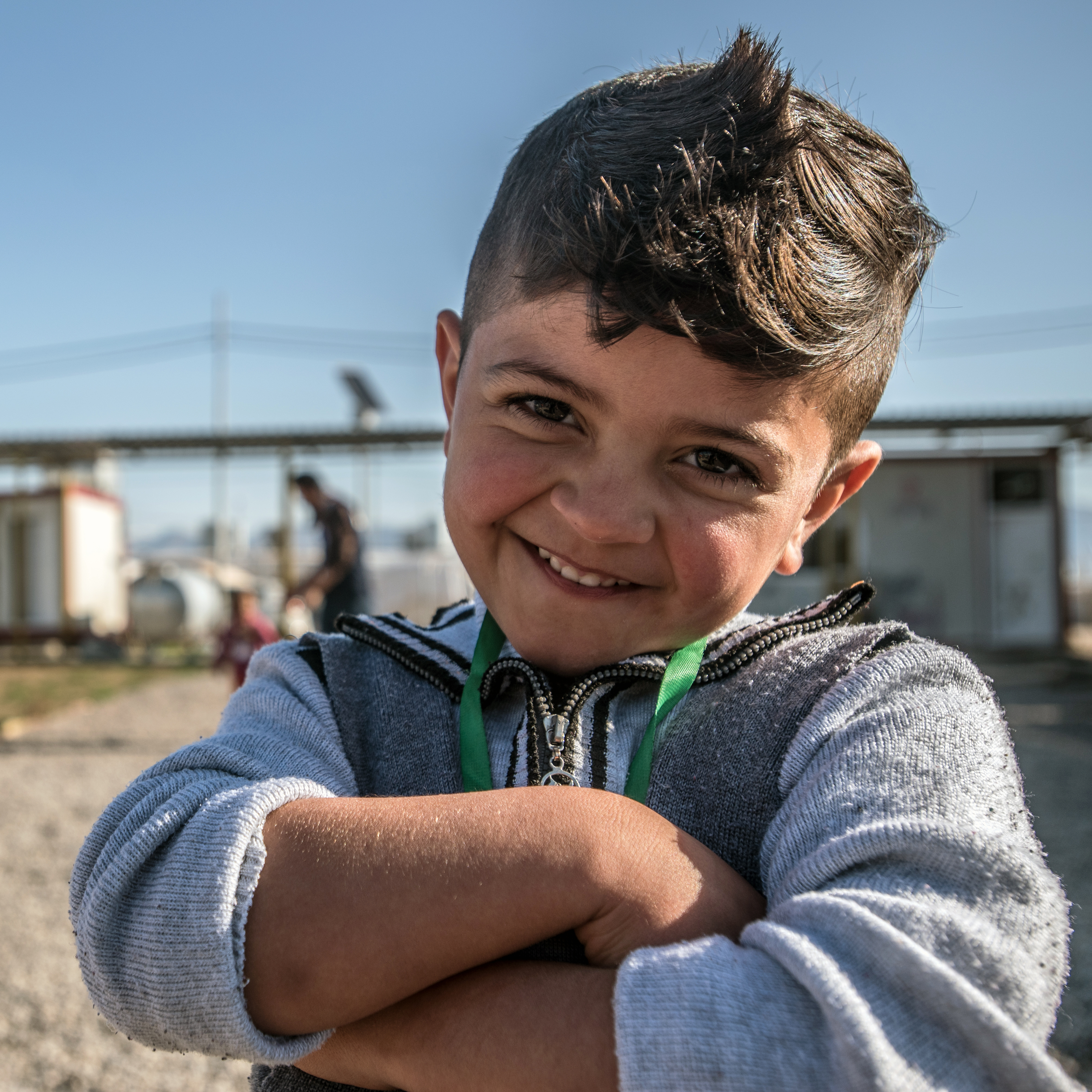
In November 2013, I received a request via the Waldorf kindergarten mailing list asking whether there was a Waldorf kindergarten teacher who could accompany an emergency education team from the Friends of Waldorf Education to a Syrian refugee camp in northern Iraq to organise activities for the young children there. At the time, I was working in a Waldorf kindergarten in Berlin Kreuzberg and had two Syrian boys in my group. The war in their parents’ homeland was clearly affecting the children and was very much on our minds. My first assignment: blue and white are the colours of the tents and tarpaulins providing shelter here in Domiz, northern Iraq, for the 140,000 mostly Kurdish refugees from Syria. Protection was critical: from the scorching summer sun, with temperatures reaching up to 50 degrees, from the dust, and in the winter from the cold, mud, wind and snow. The ground here is loamy and sticks to your wellies. Nevertheless, people are neatly dressed, and laundry is drying everywhere between the tents. On a stone it says: “Hope is everything!”
The mission in Domiz was followed by further missions in northern Iraq, Nepal, Slovenia, Lebanon and the Ahr Valley. Everywhere I met children who were so keen to imitate, who soaked up everything offered to them like sponges: singing, dancing, playing games and doing crafts. How delighted the children were during the sing-along “Show us your feet, show us your shoes”, when they realised what the movements were telling them. Beaming with joy, they pointed to the washing drying on a line between the tents.
After the major flooding, I supported the Pusteblume nursery on the edge of the Ahr Valley as an emergency teacher. Here I observed how the children process their experiences through play: cars are buried in the sand and dug out again; in play, the children flee from the water to the playhouse; in play, they begin to heal; in play, a fairy appears and casts a spell so they can breathe underwater. In play, there can be a happy ending.
I was particularly struck by the account of a nursery teacher who told me that she had forgotten almost all the songs, games and rhymes she had regularly used with the children before the disaster. Only a few, namely those recited every day at the nursery, such as the meal-time rhyme, were still accessible after the horror of the flood.
So, I wish for every child to have caring, nurturing people around them who bring firm rituals into the children’s lives, rituals that touch the children’s souls so deeply that they can draw on them even in times of need. The trauma therapist Kati Bohnet from Berlin calls these rituals ‘brushing teeth for the soul’.
For me, emergency pedagogical interventions are an opportunity to rebuild connections that have been severed by a traumatic event. They give me the assurance that children and adults are seen and acknowledged in their experiences and their struggle to survive. During these interventions, I am inspired and grateful to witness that there are people everywhere who mobilise their strength so that the children entrusted to them do not break under the weight of their traumatic experiences.
I have gained hope that a small spark can ignite the power of self-healing, that every child has a bright future. After the many experiences during these missions, which have been very instructive for me too, I am certain: joy heals! And as it says on the stone in the middle of the refugee camp: hope is everything!
Zoe Besand