


When we arrive in Pokrov, we are warmly welcomed by the staff from our partner organization SviTy. As we all sit down together, the air raid sirens start howling. This is a daily occurrence that no longer causes anyone here to panic. For us, however, a visit to that part of Ukraine means a very high level of security precautions, more than with other emergency pedagogical missions. Among other things, three escape routes were worked out in advance so that we could leave the region in an emergency. A quick glance at government information sources during the alarm reveals that the danger applies to the entire surrounding area, but not directly to the town of Pokrov. Yet the sirens remain a constant reminder of the ongoing danger of the front line, which is only a few kilometers away.
With their project, the SviTy team brings emergency and trauma pedagogical work to schools and kindergartens in the Nikopol district, a region of Ukraine that is under constant attack. Especially children suffer from the consequences of war: forced displacement, loss, constant sirens, and permanent danger—all of which have become sources of chronic stress and lead to an accumulation of psychological strain. Emergency pedagogy is urgently needed here.
The air raid sirens are one of the biggest challenges for the children. School as well as emergency and trauma pedagogical activities often have to be interrupted because the children have to seek safety in the shelters: “The shelters make the children, especially the younger ones, very afraid,” says Hanna. When we accompany the team to a school, the students are just leaving the shelter after the alarm has been called off. We take a look into the shelter: it offers physical protection, but it feels distressing and confining. The students often wait here for hours; it is difficult for us to imagine how concentration, development and joy can arise in this environment. The SviTy team began to transform the children's fear, Alona reports: “When we went to the shelter, we started singing a ‘shelter’ song we had written ourselves to calm the children's fears. The children enthusiastically joined in, running to the beat, laughing, and those who had been crying stopped. The teachers say they now use this method regularly.”
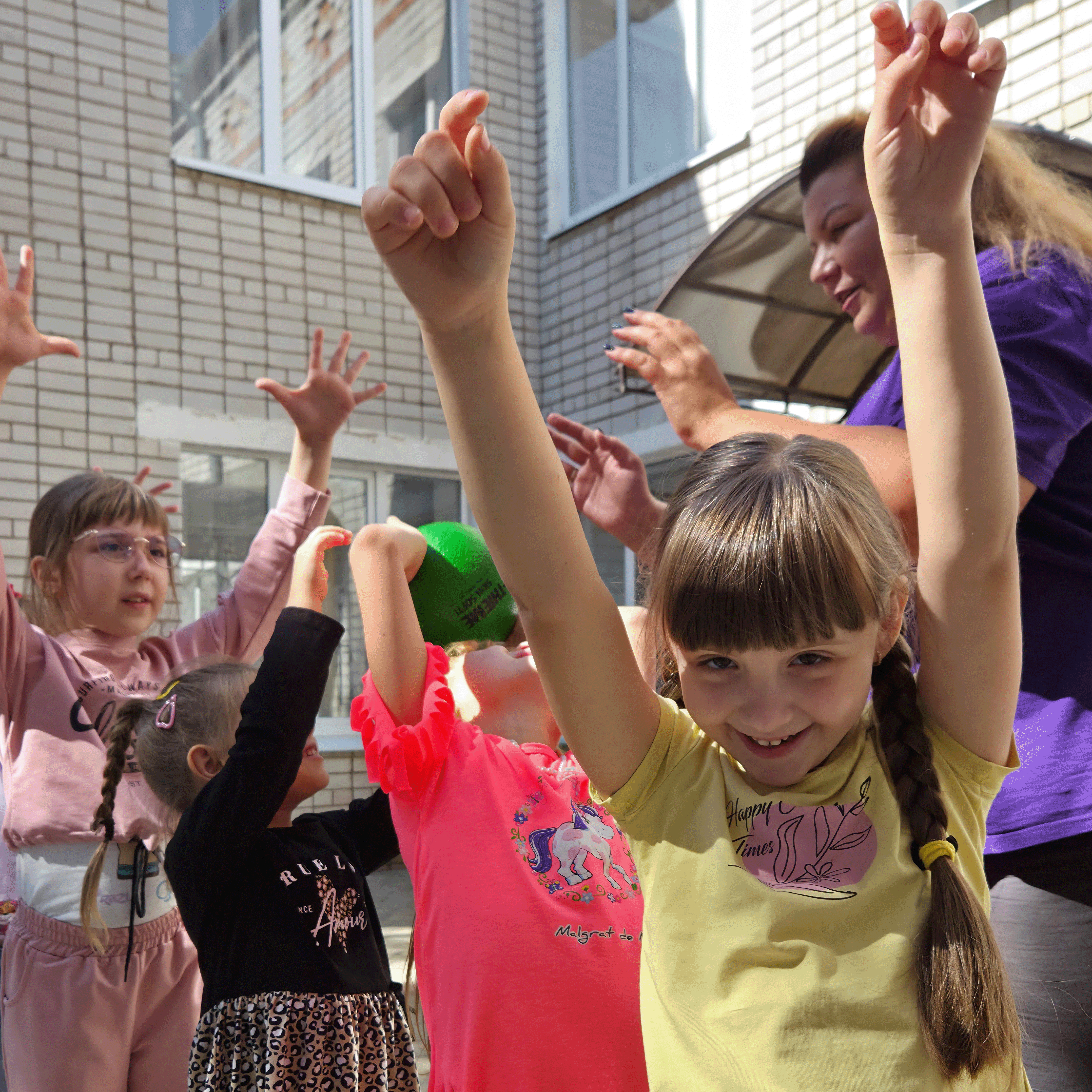
The SviTy premises are filled with a positive atmosphere thanks to their colorful and creative interior design and the loving nature of the team; they form a stark contrast to the reality of life during the war. During our visit, the children rush enthusiastically towards Alona, Hanna, and Nataliia. Many of the children in the neighborhood are internally displaced persons from areas that have already been taken by Russian troops. During the activities, we can see how much joy the children take in participating and how grateful they are for the opportunity. In the questionnaires, in which the children rate their well-being on a scale of 1 to 10 before and after the activities, one child writes down 10,000 for “after.”
What immediately strikes us is that the team complements each other very well, with each of the three women bringing their own qualities to the table. “We were united by the desire to help people.” Alona, Hanna, and Nataliia jokingly compare themselves to the four elements: they represent fire, water, and earth, with emergency pedagogy serving as the fourth element: air. “Emergency education gives us the strength and direction that drives us forward today,” says Nataliia.
After just a few months, the team noticed progress in many children and teachers: students who had previously cried during the sessions learned to recognize, name, and regulate their emotions. They participated more actively, their mood improved, and their verbal activity increased. Teachers also participated more and more in the activities and showed increasing interest in learning. “We saw how the children changed,” says Alona. “Those who were quiet at first or didn't want to get involved began to play with others. Some children with developmental problems gradually opened up and showed that they could participate in the activities on an equal footing with their peers.”
Being on the road with the team also means experiencing the everyday life of those involved during the visit: Alona and Hanna, for example, like to sing in the car on the way to distant schools—another strategy for coping with fear: “Once, on the way back, we heard loud explosions very close to the road,” recalls Nataliia. “We were scared and sped up the car. For a few seconds, there was only shock and fear. Thanks to the methods of emergency pedagogy, we were able to regain our balance. I started singing, the others joined in and a minute later, when we realized what had happened, we laughed heartily.” Fortunately, there have been few such experiences so far.
Despite the constant danger, the team firmly believes that a space where children can feel joy, adults can find relief, and the community can receive support is an essential part of rebuilding society. “We persistently uphold the values of emergency pedagogy,” say the women, “because we see how it changes children. And we know that it also changes the future.”
Fabian Krämer and Kseniya Karman Samet