

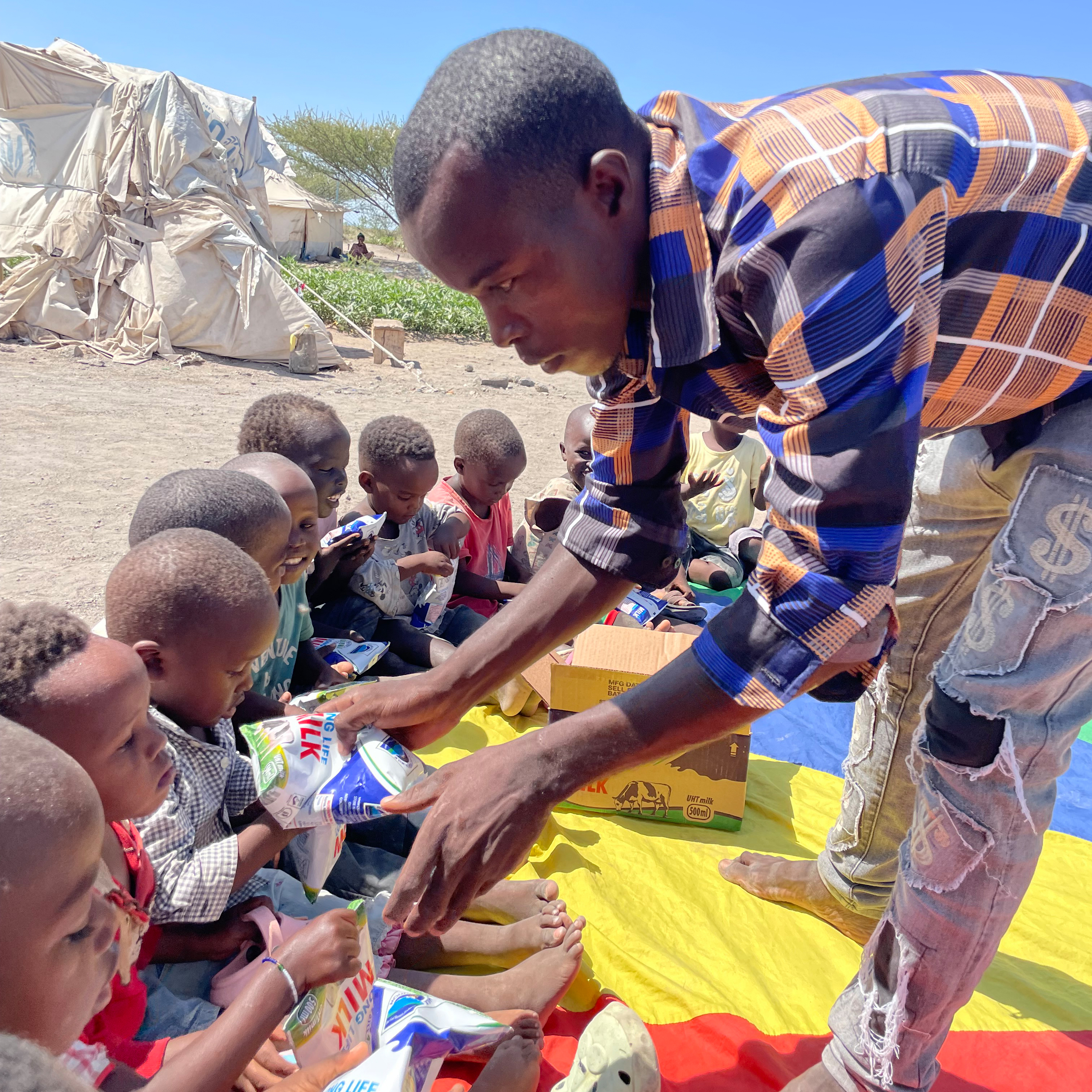
Currently, 14 teachers from the Waldorf Kakuma Project are engaged in three different Child Friendly Spaces. They are refugees themselves, also living in the camp, and come from various East African countries. Every day, they offer educational activities for around 300 children and provide them also meals such as porridge, milk, and baked goods – something especially important now as international funding cuts have also led to reduced food rations in the camps.
We spent four days on site together with Bellah Wachira and Mark Lokeny, director and project manager of the Waldorf Kakuma Project. During this time, we accompanied the team and conducted small group discussions to talk about successes, challenges, and possible solutions.
In Kakuma 4, one of many districts in the refugee camp, the team has access to its own plot of land with a small building where they conduct their activities. The district is primarily inhabited by people from South Sudan, and children between the ages of 3 and 10 participate in the activities. The day begins with a morning circle where the children move and sing. Afterwards, they are handed cups of water while sitting in a circle, accompanied by a song. Then, the children are allowed to paint freely, with their artwork often depicting plants, soccer fields, houses, and of course, little people. The day ends with the children sitting in a circle and sharing a cup of warm porridge.
The local colleagues repeatedly emphasize how important and valuable these meals are for the children. One staff member noted: “Sometimes the children don’t have the energy to come to us or participate in the activities – they’re just too tired. But after the meal, I see many of them come alive, playing and running around full of energy.”
In the reception center Kalobeiye, another part of the camp, the team has to work without permanent facilities and carries out educational activities outdoors. With a “morning train” through the camp, accompanied by singing and drumming, the team gathers the children and forms a large circle in which about 100 children sing, play, and move together. Afterwards, "small trains" are formed according to age groups. One group at a time is allowed to use the only shaded spot under a small tree, while the other groups remain in the blazing sun. Games are played, bead necklaces are made, pictures are painted, clay is modeled, and songs are sung – for a few hours, the children can immerse themselves in a world of play, away from the everyday life in the camp. At the end, they receive milk and baked goods.
The educators work under extreme conditions: unbearable heat without shade, strong winds, inadequate water supply for themselves and the children, huge groups of children without appropriate, sheltered space. In addition, they have to cope with many other challenges: children who have to carry their younger siblings, high demand during food distribution, language barriers, constantly changing groups of children, and the generally difficult living conditions in a refugee camp. Nevertheless, they manage to create an environment in which children can simply be children. “Often, I don’t even want to go home – it’s depressing. Working with the children here is like medicine for me,” said one local colleague.
We return with many impressions and new ideas for possible future projects, full of gratitude for the hospitality and the excellent work our colleagues on site are doing.
Fabian Krämer
This project is made possible thanks to financial support from Aktion Deutschland Hilft.
If you like what we do and would like to support our work, please click here: