


Many of those who fled Gaza to Egypt tend to withdraw into themselves. They either do not want to or cannot share their distressing experiences with others, and are also unable to listen to the stories of others. As a result, they often live in isolation, and the burden remains unspoken. This is particularly true for children and young people, who, apart from the online classes they receive, experience very little to no social interaction. The communication and relationship with their parents are also often disrupted by the trauma they have all experienced.
On our first day, we had the opportunity to work with twenty parents. Along with psychoeducation, we offered workshops in art and movement, and we also provided time for an open discussion round. During these, the parents shared how they feel trapped in a downward spiral since they fled. Burdened by memories, guilt, and news from home, they escape from themselves and their emotions. Most often, they turn to their phones, which offer distraction. They experience their children as being aggressive or even depressed, suffering from the lack of opportunities for social interaction. And the parents themselves, due to their own burdens, find it hard to be present and available for their children. This makes it even more crucial to establish a Child Friendly Space, where children can be regularly cared for and they can interact with friends.
Over the next five days, we met with the young educators with the goal of introducing them to psychotraumatology as well as emergency and trauma pedagogy. In addition to theoretical sessions, we offered workshops in art and movement to directly experience what the exercises do to us. What does rhythm mean? What does it mean to be artistically active? We also gave the educators insights into how they could design their time with the children in a trauma-sensitive way. Why does a child behave aggressively? What is it trying to communicate through this behavior?
Time and again, we have had the experience that workshops and training for adults are not just a place for professional learning, but also a place where they can reconnect with themselves. However, we rarely experienced this as clearly as we did in Egypt. A phrase we repeatedly heard during our time there was: “I haven’t spoken to anyone about this yet,” followed by stories of suffering and pain, the loss of loved ones and places. Salwa* for example shared how she still boils water to bather herself in pots: “How can I take a warm shower when I know my family at home has no access to water?” Fatima* reports that she often struggles to eat because she knows her friends in Gaza don’t have food. For Hala*, it feels like an achievement when she manages not to let her emotions show. Many tears were shed, but there were also many moments of joy and relief.
The music therapist Zeina expresses particularly well, how this form of encounter means far more than just knowledge transfer for the participants but also for us. In her reflection, she wrote the following:
“For me personally, the strongest realization was about the ‘iceberg’ – that what we see on the surface is only a fragment of a person’s experience. Their behavior is just the tip – underneath lies a whole other world. I will stop taking things personally. I will start asking: What might be happening beneath the surface? This shift in perspective has changed me – not only in my work, but also in my relationships with people in general.” She continues: “Emotionally, I was humbled. To be entrusted with the grief of those who mourn so deeply, to witness their tears, to listen to their stories, to share in their pain – that was an honor. There were moments when the space held more than just words or art – it held collective sorrow, courage, and a desperate longing for peace. We cried together. We created together. We found insights into healing together. I felt that I was exactly where I needed to be. For a long time, I carried a sense of helplessness with me. But during these days of workshops, this helplessness turned into action, connection, and presence. I felt I was doing something that mattered. No matter how small, it was important.”
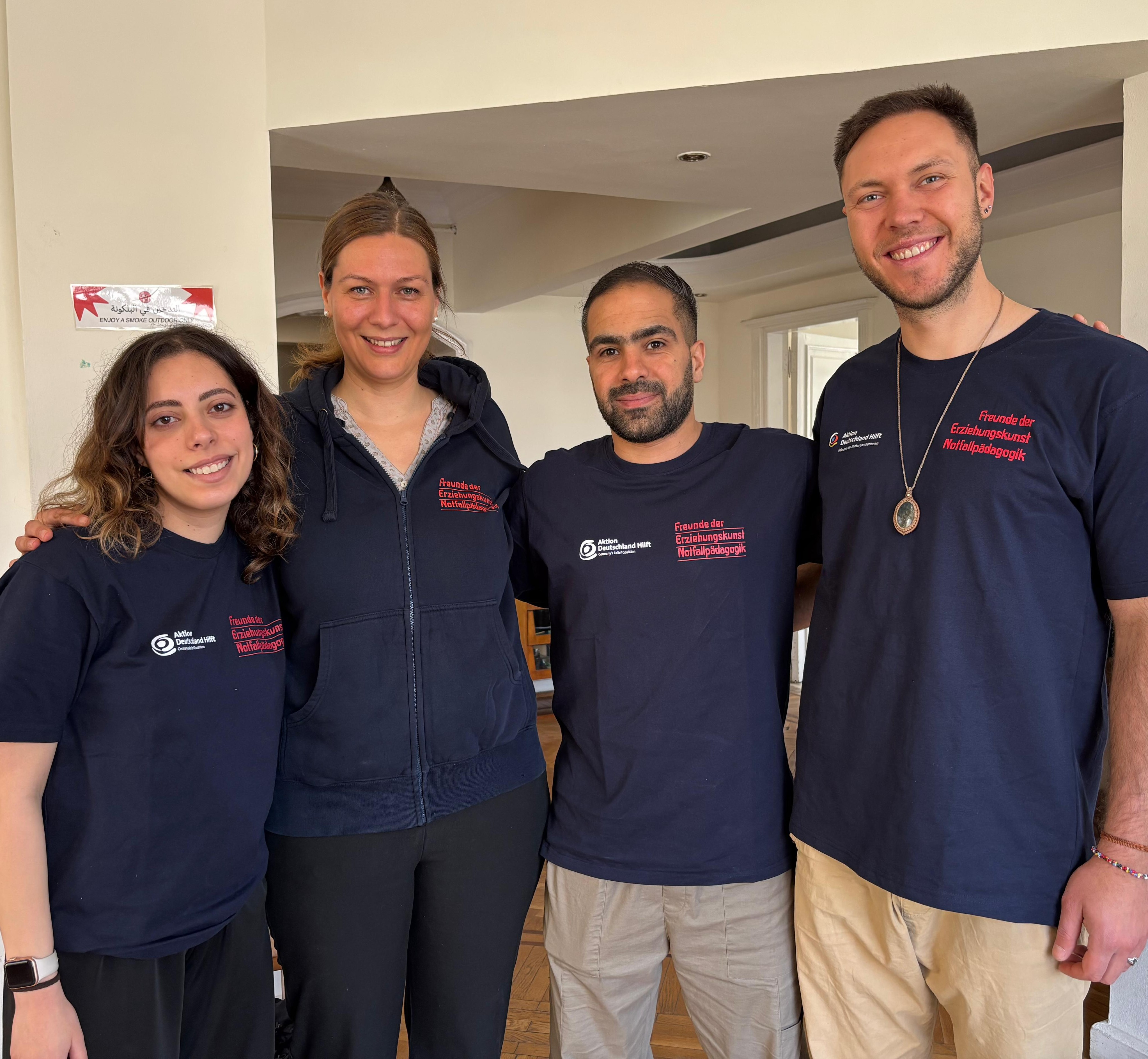
Zeina and Ahmad, the dance therapist, repeatedly emphasized how valuable and meaningful this workshop was for them as well – especially because they could share many experiences and feelings with the participants. In our debriefings, they shared with us the moments that had particularly touched them.
One example that particularly moved us: A participant shared that since his escape from Gaza, he has been suffering from severe sleep disturbances. On good days, he sleeps no more than three hours – before the workshop, he had not slept properly for six days. But after the first day of our workshop, he slept a full ten hours. Both he and his mother were very surprised. He reported that he had felt an inner calm that seemed long lost.
It was especially enriching to observe how the group grew closer over the week, taking a small step out of isolation. Everyone agreed: Together, we can offer the children a safe place! The newly gained energy from the training was immediately put to use by the team from Gaza, who organized the first day for the children. In the future, regular activities for the children will take place.
In gratitude for this special week, which was made possible through the support of Aktion Deutschland Hilft,
Fabian Krämer and Fiona Bay
*The names of the participants have been changed.