
After the war in the Tigray-Region Emergency Pedagogy for children and students in Ethiopia
[13.05.2024] - For two years, a bitter civil war raged in northern Ethiopia, and even after signing a peace agreement, violent clashes continue to this day. The conflict between the regional government of Tigray and the Ethiopian central government resulted in countless deaths and forced more than 1.2 million people to flee, with millions more relying on humanitarian aid. Currently, there is a great risk of famine in the region. In April, an international emergency pedagogical team from Friends of Waldorf Education was able to work in the region. For two days, the emergency pedagogues worked at a Waldorf school in Hawzien. After that, the team travelled to Shire to work at a rural school with a total of 1,200 children.
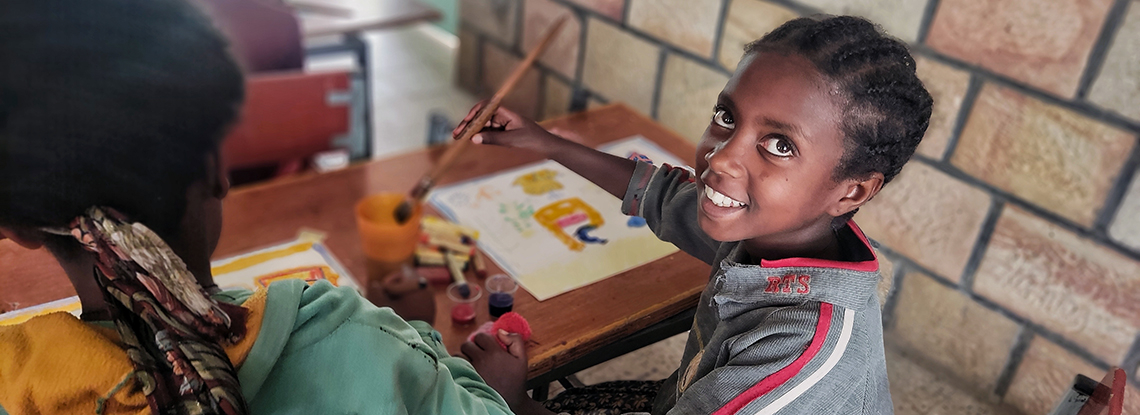
The Waldorf school in Hawzien is located very close to the Tigray region and was thus caught up in the midst of the war: soldiers used the school as accommodation. In the process, a large portion of the furniture and the entire kitchen equipment was stolen. "There are no more pots left," reported the school's founder, Atsbaha Gebre-Selassi, during a visit in Berlin. "Everything that was reasonably easy to transport was taken – only the very small chairs from the first grade were left behind." The solar system, which was supposed to operate the pump for the well, built shortly before the war, was also taken. Additionally, two classrooms were severely damaged by a fire. The school, predominantly attended by children from economically disadvantaged backgrounds, has been supported by the international cooperation of Friends of Waldorf Education for many years. The support mainly funded teacher trainings and salaries, but also helped with forwarding donations for school meals.
Now, an emergency pedagogy team from Friends of Waldorf Education was also able to carry out an introductory seminar on the basics of Emergency and Trauma Pedagogy for teachers. Teachers from the Waldorf School as well as from 11 other schools in the surrounding area were invited. "This work was very important for the teachers," reports Gebre-Selassi. The colleagues, he says, felt much calmer afterwards and felt better equipped for their work with the children at the school. "The help came at just the right time."
After the training in Hawzien, the team travelled to Shire to work with approximately 1,200 children at the local Don Bosco School. Striking is that there are currently 6 8th grades in the school in Shire and also several 8th grades in Hawzien. Due to the Covid-19 pandemic and the war many children could not attend and had to repeat classes, which results in such as large number of 8th grades now.
In Ethiopia, the Friends are still at the very beginning of the emergency pedagogical work process. What can teachers do to support students in processing traumatic events? What do the teachers themselves need to be able to stand strengthened in front of a class and teach again, after their own traumatic experiences? To deepen the basics from the introductory seminar, another international team will travel to Hawzien in July. The school garden, which was destroyed by the war, will be rebuild together with the local colleagues, as will the playground and other school facilities.
Additionally, the long school summer holidays are just around the corner. For many children this is not a joyful prospect, as they have only now regained a sense of normality through the school after the turmoil of the civil war. The Emergency Pedagogy of Friends of Waldorf Education supports the school in offering artistic, creative, and practical activities for the children during the holidays. Trauma processing and healing knows no holidays and the children need a safe space and reliable relationships beyond official holidays, and this is precisely what the Waldorf School in Hawzien means to many children. Our emergency pedagogical work in Ethiopia is made possible through funding from Aktion Deutschland Hilft (Germany‘s Relief Coalition).